The short version
NASA's Roman Space Telescope, launching in August, will explore dark energy and galaxies while also being repurposed to hunt potentially hazardous asteroids.
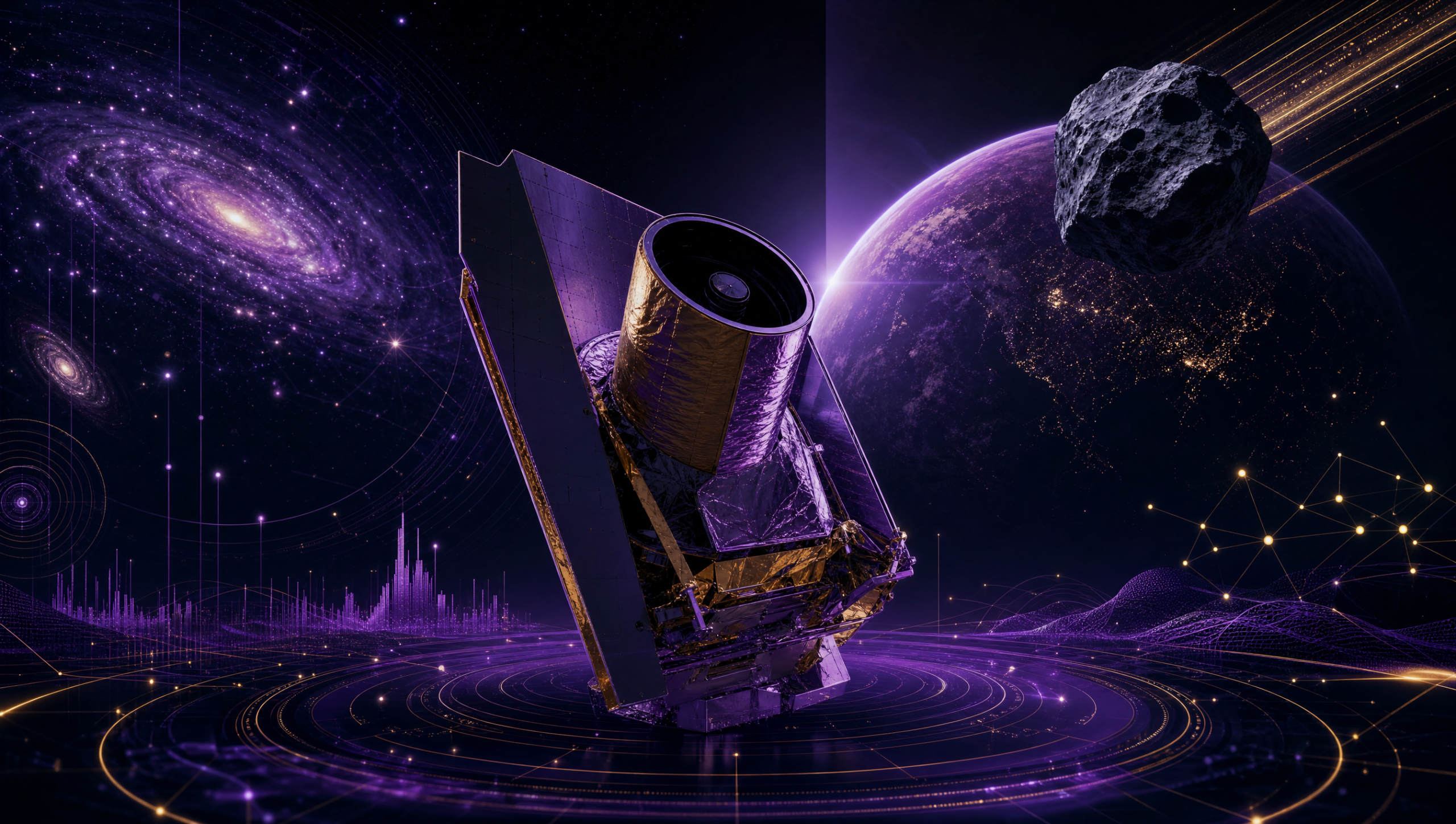
NASA will launch the Nancy Grace Roman Space Telescope in late August. Its main goal is to investigate dark energy and dark matter by surveying over a billion galaxies, but it also has a surprising, secondary use for planetary defense. The telescope’s huge field of view lets it efficiently scan for asteroids that might threaten Earth.
Key takeaways
- The Roman Space Telescope launches in August 2024 to study dark energy and dark matter.
- Its wide-field infrared camera can survey the sky 100 times faster than Hubble.
- Not originally designed for it, Roman can spot small asteroids by analyzing discarded data streaks.
- This planetary defense role was emphasized to secure funding after threats of budget cuts.
- Roman will complement other observatories like JWST by quickly identifying asteroids for follow-up study.
The Roman Space Telescope’s Launch and Primary Scientific Mission
NASA will launch the Nancy Grace Roman Space Telescope from Kennedy Space Center in Florida at the end of August. Its primary mission is to help us understand how the universe works, from the glue-like dark matter that holds galaxies together to the elusive dark energy that pushes the cosmos to expand.
The telescope carries a super-wide-angle, 300-megapixel infrared camera. This lets it see a vast area of space at once—about 100 times larger than the Hubble Space Telescope’s view. It will find thousands of new planets, tens of thousands of exploding stars, and survey over one billion galaxies in fine detail.
A Strategic Pivot to Planetary Defense
Although not built for this purpose, the Roman Space Telescope is perfectly positioned to find asteroids as it looks ‘through’ our solar system during its surveys. In September, a multi-institutional team will propose how Roman can scan asteroids to provide data on their paths, sizes, and compositions.
Scientists highlighted this planetary defense capability to raise the mission’s profile with lawmakers and taxpayers after funding cuts were threatened. A researcher pointed out the need to demonstrate Roman’s value for planetary defense when the mission faced significant budget reductions.
Roman’s huge field-of-view and infrared vision enable it to spot small asteroids up to 60 feet long, similar to the one that exploded above Chelyabinsk in 2013. Its wide-angle infrared camera sees a patch of space about 100 times larger than Hubble’s view.
To find asteroids, Roman’s software will need modification. It currently discards streaks—including those from asteroids—to get clear pictures of the distant universe. Astronomers could then examine the discarded data to find and identify asteroids.
Technical Capabilities and Synergy with Other Observatories
The Roman Space Telescope’s software discards streaks—from cosmic rays, glitches, or asteroids—to gather clear pictures of the distant universe. However, astronomers can study these discarded streaks to find and identify asteroids. Its power comes from working with other observatories like the James Webb Space Telescope (JWST).
Wide-Field Advantage
Roman’s super-wide-angle, 300-megapixel infrared camera gives it a field of view about 100 times larger than Hubble’s. This means it can examine many potential asteroids very quickly. As planetary scientist Andy Rivkin says, “Roman’s field of view is much bigger” than JWST’s, which is built to focus intensely on single targets for follow-up.
This lets Roman provide infrared observations of more asteroids in a reasonable time than JWST could manage. If those asteroids are potential threats, other telescopes, including JWST, can conduct follow-up observations. These observations give experts the data needed to assess likely impact damage or to plan a mission to deflect a hazardous asteroid.
The Broader Context of Asteroid Detection and Defense
NASA’s Planetary Defense Coordination Office is primarily concerned with asteroids 460 feet long and larger. Scientists estimate about 25,000 of these have near-Earth orbits, and just over half remain undiscovered. Astronomers also think there are roughly 230,000 asteroids about 165 feet long orbiting close to Earth, with less than 10 percent found. An impact from one of these would release energy similar to a large atomic bomb.
Limitations of Ground-Based Surveys
NASA funds a network of ground-based telescopes designed to find these objects. They perform well, but they can only see a limited portion of the night sky, and Earth’s atmosphere obstructs their view.
The Role of Future Space Telescopes
This is why NASA is launching the dedicated Near-Earth Object (NEO) Surveyor space telescope in 2027. By positioning itself between Earth and the Sun, it will find many hard-to-see asteroids that ground-based telescopes miss. It will see in infrared light, not visible light. Asteroids show up more clearly in infrared, and viewing them this way gives scientists a much better measure of their size.
📡 Original reporting: MIT Tech Review. AI Craft Technologies’ news engine summarised and rewrote this story in our own words; facts are drawn from the linked source.
⚙️ How this article was made — fully automated
This is a live demo of the ACT News Factory engine. Want one running on your own site? See our services →