The short version
AI engineering evolves from prompt crafting to loop design and graph orchestration, each layer adding control for more complex, automated tasks.
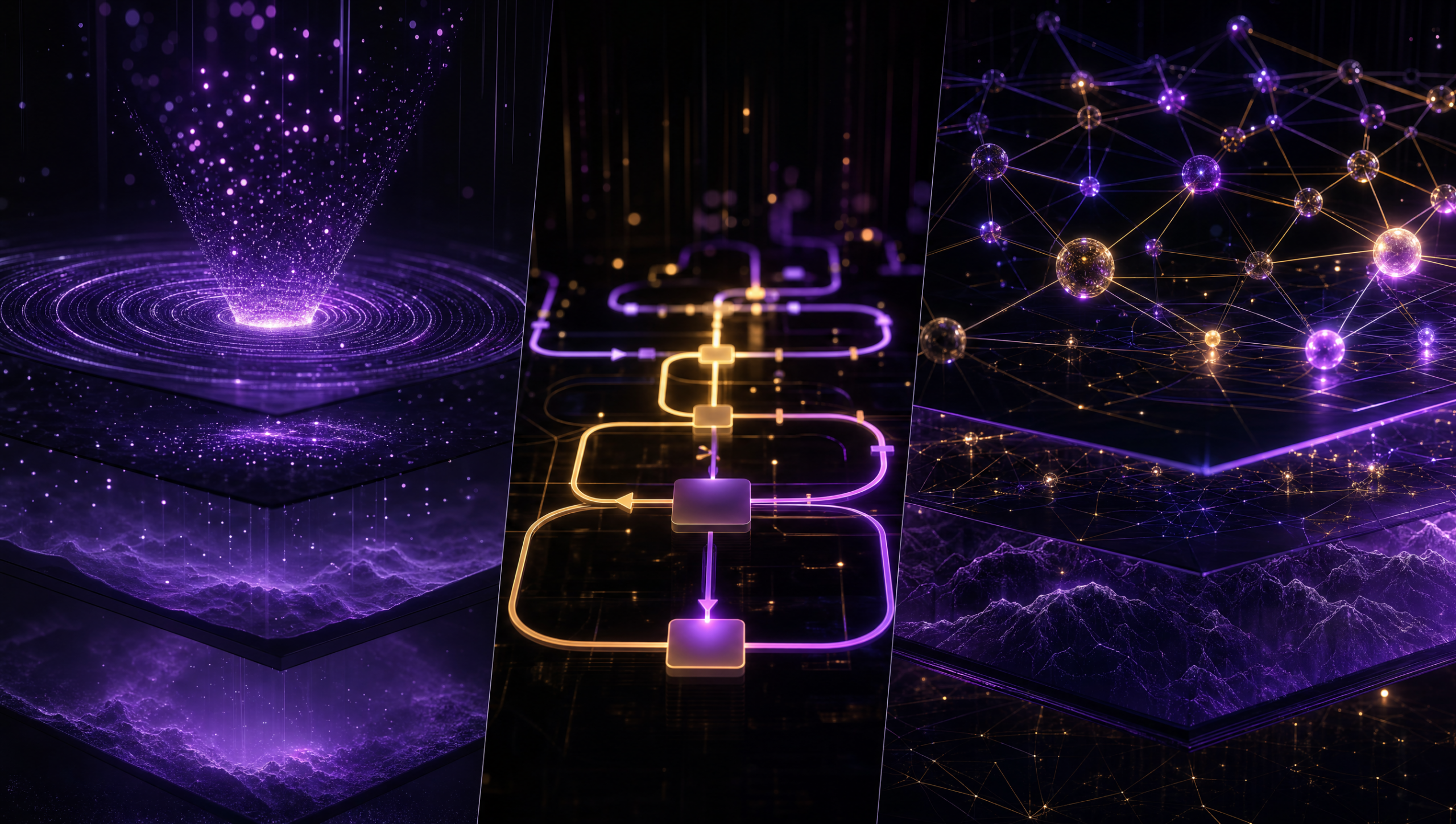
This article outlines a progression in AI development from prompt engineering to loop and graph engineering. Each layer defines a distinct control unit, building on the previous one to manage more automated and intricate workflows. This layered method lets systems advance past simple, supervised exchanges to coordinated multi-agent groups.
Key takeaways
- Prompt engineering concentrates on creating instructions for a single model call, assuming a person is watching.
- Loop engineering defines the goal, tools, and cycle for an autonomous agent’s actions, needing a mechanical stop condition.
- Graph engineering arranges the structure of several agents, frequently using stable org graphs and temporary work graphs.
- These layers build on each other; each one keeps the control of the layer below.
- The vocabulary for graph engineering is recent and discussed, but the core orchestration ideas have been part of multi-agent research.
Layer 1: Prompt Engineering
Prompt engineering means writing and shaping the instruction for one model call. The key assumption is that a person reviews every output and adjusts the prompt. This approach fails for high-volume jobs, multi-step procedures, a missing human reviewer, or when results automatically trigger the next step. Here, the prompt alone falls short because the operating environment shifts, not the prompt.
Prompt engineering persists even within advanced control layers like multi-agent systems. It stays a main tool for solving problems. For instance, Anthropic’s multi-agent study found prompt engineering was the chief way to fix coordination breakdowns, like a system creating too many subagents for straightforward questions, instead of changing the system’s structure.
Layer 2: Loop Engineering
Loop engineering involves designing the goal, tools, and cycle for an agent’s actions, going beyond just the prompt. This term gained wider use among developers in June 2026.
Key Primitives
A thorough public analysis lists several core parts. Automations manage unsupervised discovery and triage. Worktrees offer isolation so parallel agents cannot edit identical files. Skills get documented in a project file like SKILL.md to prevent repeated explanations. Plugins and connectors provide API access to tools such as issue trackers. Sub-agents allow a maker/checker split, since the model that writes code often grades it too leniently. External state management, using a markdown file or board, is essential because the model loses memory between runs.
The Critical Challenge
Setting a mechanical stop condition is the tough part. A loop that cannot tell completion from being stuck will not fail clearly and will keep spending tokens without end, draining resources.
Layer 3: Graph Engineering
Graph engineering appeared in July 2026, after loop engineering’s earlier rise. Its main innovation is making agent groups programmable, building directly on loops which first made single agent behavior programmable.
Dual-Graph Architecture
In practice, production multi-agent systems usually run two graphs at once. The first is a stable org graph for long-lived agents that hold named roles, own a specific area, and gather context over time; this graph only changes on system redeployment. The second is a temporary work graph made of task-specific nodes and edges that exist only while the job is active. These edges split for parallel execution, merge upon convergence, and vanish when evidence makes a branch unneeded.
Terminological Skepticism
Doubts about the “graph engineering” label are reasonable. One source notes the term’s origin is unclear and it conflicts with older knowledge-graph ideas. The core technology for sub-agents with set purposes already created a graph structure well before this specific term was formally used in mid-2026, as shown by tools like LangGraph releasing their graph API earlier.
The Stacked Progression of Control Units
Prompt, loop, and graph engineering are not rival methods but stacked control units. A prompt directs one model response, a loop directs one agent’s action cycle, and a graph directs the structure of many agents. Each layer maintains the one below it; a prompt does not vanish once inside a loop but stops being typed by hand.
Building the Stack
This progression got its name in practice before showing up in vendor docs. Loop engineering builds on earlier layers like context engineering (optimizing token use) and harness engineering (the environment a single agent runs in). A specific framework puts loop engineering directly above this harness layer, defining how a system repeatedly observes, acts, checks, and recovers.
The Newest Layer
Graph engineering is the most recent and least fixed label, with its origin still debated. Yet the core practice—graph-based orchestration—has a recorded history in multi-agent systems research. In this stack, graph engineering stands as the control layer for organizing many agents, sitting above loop engineering.
📡 Original reporting: MarkTechPost. AI Craft Technologies’ news engine summarised and rewrote this story in our own words; facts are drawn from the linked source.
⚙️ How this article was made — fully automated
This is a live demo of the ACT News Factory engine. Want one running on your own site? See our services →