
The short version
Silicon Valley's AI 'solutionism' promises utopia but economist Branko Milanović's model predicts it will create a deeply stratified four-class society, from a 'surplus population' to a new tech arist
The core belief pushing Silicon Valley’s AI vision is ‘solutionism.’ This idea turns intricate social issues into neat problems with computable fixes. This mindset, supercharged by AI, pledges a world remade by tech but often ignores real-world details and outcomes. Economist Branko Milanović gives a clear picture of the likely social structure, forecasting a society split into four separate and unequal classes.
Key takeaways
- Silicon Valley’s AI vision is pushed by ‘solutionism,’ an idea that treats complex social issues as problems with clean, algorithmic fixes.
- Economist Branko Milanović sketches a future society split into four distinct classes from unchecked AI use.
- The lowest tier is a politically charged ‘surplus population’ (15-20% of workers) with outdated skills, possibly needing state aid to keep peace.
- Above them sits an unstable service-sector working class, living with the steady risk of falling into the surplus group.
- The elite includes a rising ‘homoploutic’ professional class and, at the peak, a fresh aristocracy of immensely rich ‘tech lords’ who own the AI.
The ‘Solutionism’ Mindset of Silicon Valley’s AI Evangelists
The central belief driving Silicon Valley’s AI vision is “solutionism,” a term from technology writer Evgeny Morozov. This mindset reframes complex social events in politics, health, and learning as tidy issues with clear, calculable fixes that algorithms can optimize.
This belief is common among tech leaders, who mostly have narrow STEM histories. They imagine AI fixing everything from the climate crisis and cancer to raising output and multiplying gross domestic product. Figures like Anthropic’s Dario Amodei show this by making broad, clashing forecasts, like AI ending half of entry-level jobs while also predicting a 95% drop in cancer death and cases in the same short span.
Solutionism has been widespread in Silicon Valley, but AI’s arrival has powerfully accelerated it. This pledges a world changed by technology, but the mindset often shows a gap from real-world details and results, with leaders making big statements from inside a “reality distortion field.”
Economist’s Model: AI’s Path to a Four-Tier Social Stratification
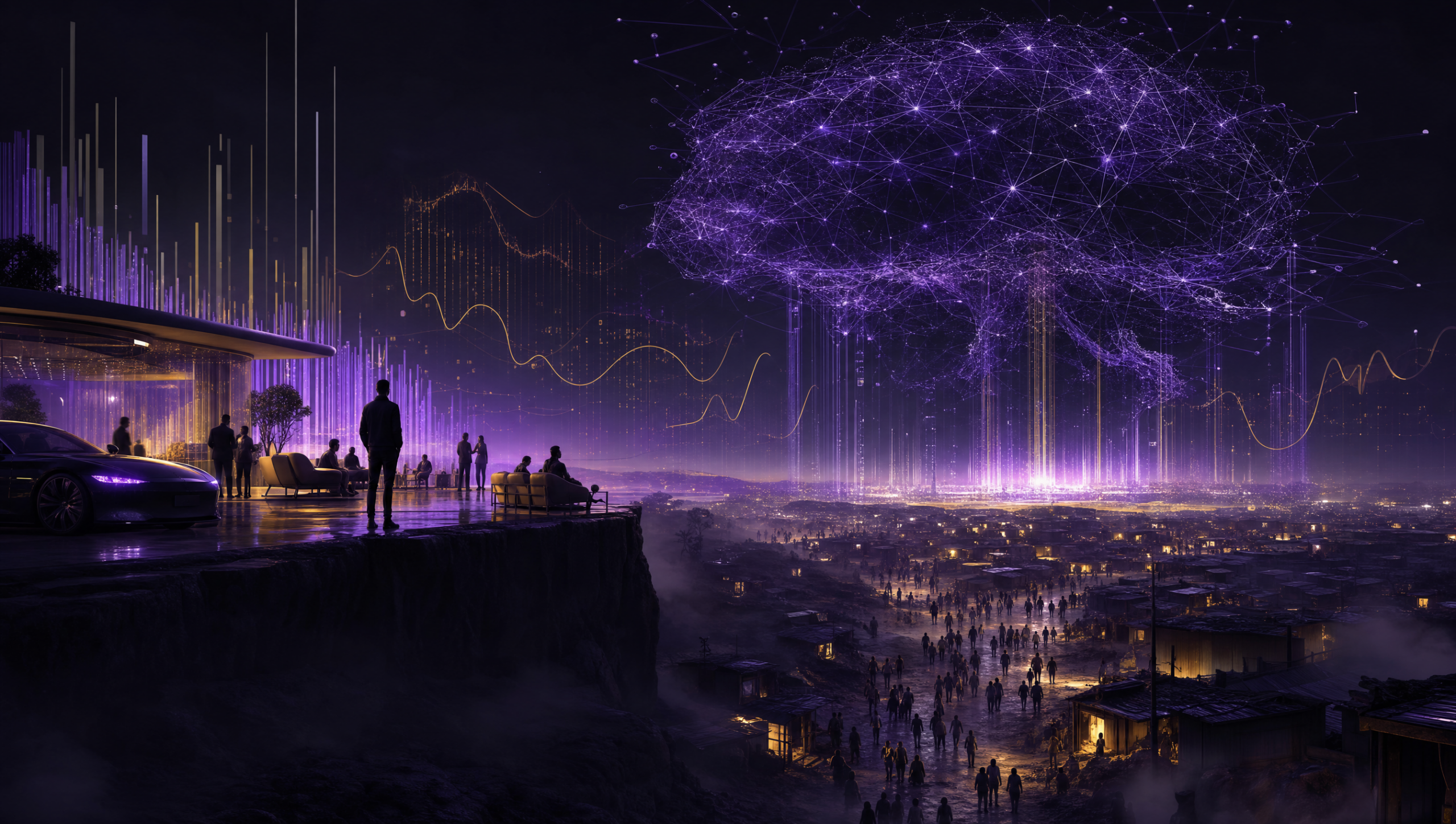
Economist Branko Milanović gives a sketch of the social structure likely to come from the unchecked use of AI as tech leaders see it. His model forecasts a society sharply split into four separate social classes.
The Bottom Tiers: Surplus Population and Precarious Service Workers
At the base is what Milanović names the “surplus population”—people whose skills AI makes outdated and who are judged to have little industrial worth. He believes this group might make up 15-20% of the workforce, a scenario he cautions could turn politically charged, possibly needing lifelong jobless benefits and non-stop entertainment to preserve social calm.
Just above them, Milanović predicts an unstable “service-sector working class.” This class includes those AI hasn’t replaced yet but who live on low-to-moderate pay under the steady risk of dropping into the surplus group.
The Emerging Elite: Homoploutic Class and a New Tech Aristocracy
Economist Branko Milanović sketches a society sharply split from unchecked AI use. The third tier is the “homoploutic” class, including those in both the top 10% of capital owners and the top 10% of wage earners—now about 3% of the U.S. population. This group holds professionals like lawyers, surgeons, and corporate leaders.
A Growing Elite
Milanović believes AI will likely expand this homoploutic group. Their high mix of labor and capital income lets them keep investing in the most profitable parts of the new economy, protecting and enriching them more.
The Peak of the Pyramid
At the very top, the model pictures a fresh aristocracy of “tech lords.” This is an immensely rich elite of thousands—not just the present 0.001%—who own the AI technology itself and hold oversized political power. This structure shows a logical extension of Silicon Valley’s solutionist dreams, shifting from visions of AI-led plenty to a reality of lasting inequality and political unrest.
From Promised Utopia to Political and Social Instability
The picture of AI-led plenty and optional work, pushed by figures like Elon Musk, instead creates a deeply unfair and politically shaky society. Economist Branko Milanović’s model shows the tech industry’s transformative vision for AI leads to a ‘brave new nirvana’ defined by sharp class splits rather than shared gain.
A Stratified Society
Milanović sketches a society sharply split into four social classes. At the base is a “surplus population”—people whose skills AI makes outdated, viewed by Silicon Valley as having little industrial worth. If this group hits 15-20% of the workforce, it could turn politically charged, needing to be kept “quiet and docile” through steps like lifelong jobless benefits and steady low-cost streaming entertainment.
Above them sits an unstable “service-sector working class” under constant threat of falling into the surplus group. The next tier is the “homoploutic” class—professionals in the top 10% of both capital owners and wage earners. At the peak rests a fresh aristocracy of tech lords: an immensely rich elite who own the technology and hold oversized political power.
The result is a society where the promised fixes for global issues instead lock in large class divisions, making AI the issue for everyone outside the elite.
📡 Original reporting: Hacker News · AI. AI Craft Technologies’ news engine summarised and rewrote this story in our own words; facts are drawn from the linked source.
⚙️ How this article was made — fully automated
This is a live demo of the ACT News Factory engine. Want one running on your own site? See our services →